
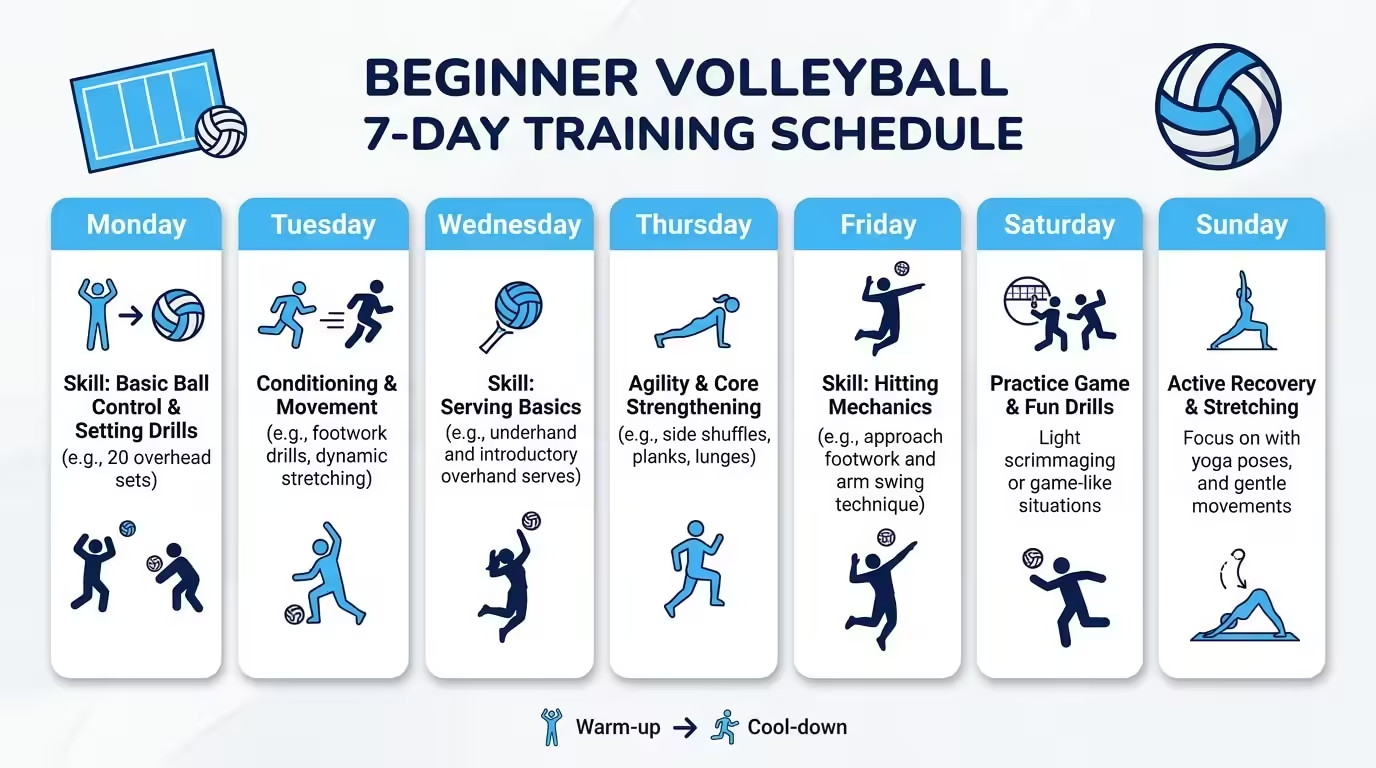
Master the fundamentals safely and effectively with this comprehensive Volleyball Weekly Training Program for Beginners. Explore an incredible 7-day schedule featuring daily drills, solo/team options, and essential recovery tips.
If you are new to the sport, stepping onto the court can feel overwhelming. The hardest part is rarely the desire to improve—it is knowing what to do first. That is why following a dedicated Volleyball Weekly Training Program for Beginners is essential. Without a structured Volleyball Weekly Training Program for Beginners, you might spend one session passing until your arms are sore, another trying to serve with no plan, and wonder why progress feels so slow. Conversely, you might fall into the trap of practicing too much, too soon, without enough recovery, losing motivation as your body grows tired.
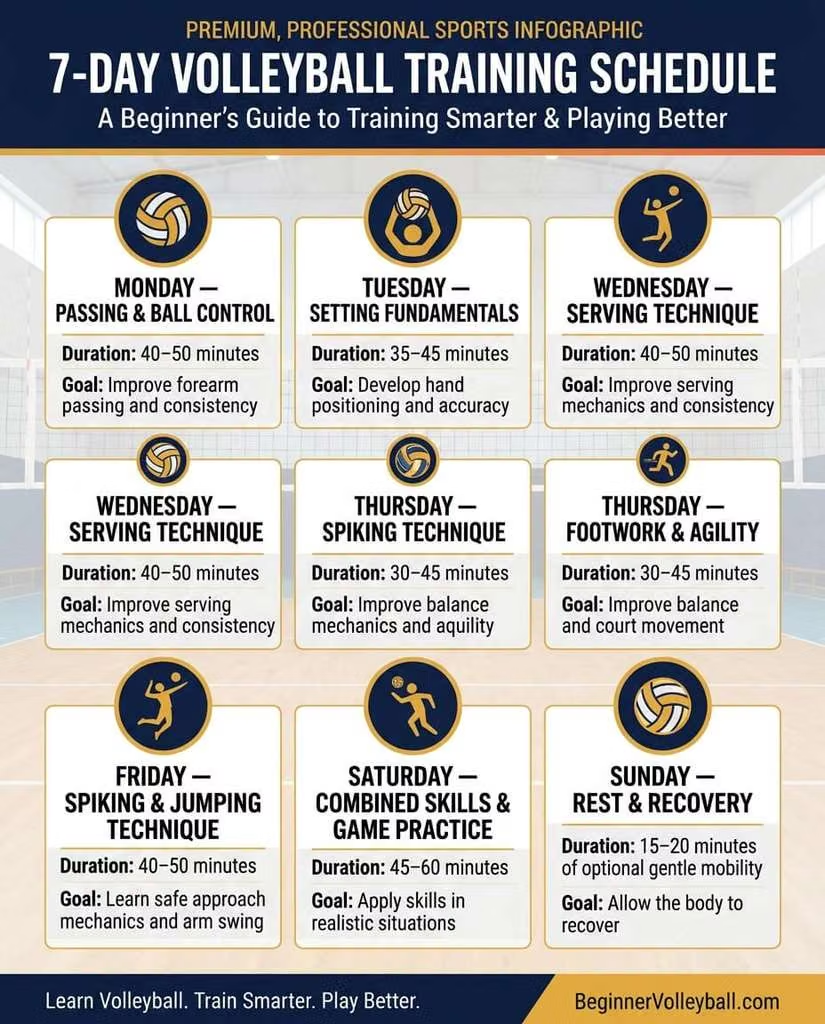
Implementing an effective Volleyball Weekly Training Program for Beginners solves this challenge. Instead of guessing what to practice, you follow a balanced schedule designed by our Volleyball Weekly Training Program for Beginners framework to build passing, setting, serving, movement, and hitting in a logical sequence. Short, focused repetitions with proper technique emphasized throughout any good Volleyball Weekly Training Program for Beginners are far more valuable than long, exhausting sessions that breed bad habits. For additional coaching frameworks and youth sport guidelines, you can also explore resources from USA Volleyball.
How the Weekly Training Structure Works
For beginners, 3 to 5 training sessions per week is the sweet spot. This comprehensive Volleyball Weekly Training Program for Beginners includes six short training days and one recovery day, mixing skill-focused sessions with high-movement days.
- Session Duration: 30–60 minutes (including warm-up and cooldown).
- Training Format: Adaptable for both solo practice (wall drills, self-tosses) and partner or team environments.
- Core Philosophy: Consistent, gradual exposure to fundamental skills rather than maximum intensity every day. You Can learn Volleyball Rotation for Beginners: 6 Easy Steps to Play with Confidence
Your 7-Day Volleyball Weekly Training Program for Beginners
| Day | Training Focus | Suggested Duration | Main Goal |
| Monday | Passing and Ball Control | 40–50 minutes | Improve forearm passing and consistency |
| Tuesday | Setting Fundamentals | 35–45 minutes | Develop hand positioning and accuracy |
| Wednesday | Serving Technique | 40–50 minutes | Improve serving mechanics and consistency |
| Thursday | Footwork, Agility, and Movement | 30–45 minutes | Improve balance and court movement |
| Friday | Spiking Approach & Jumping | 40–50 minutes | Learn safe approach mechanics and arm swing |
| Saturday | Combined Skills & Game Practice | 45–60 minutes | Apply skills in realistic situations |
| Sunday | Rest and Recovery | 15–20 minutes | Allow the body to recover via gentle mobility |
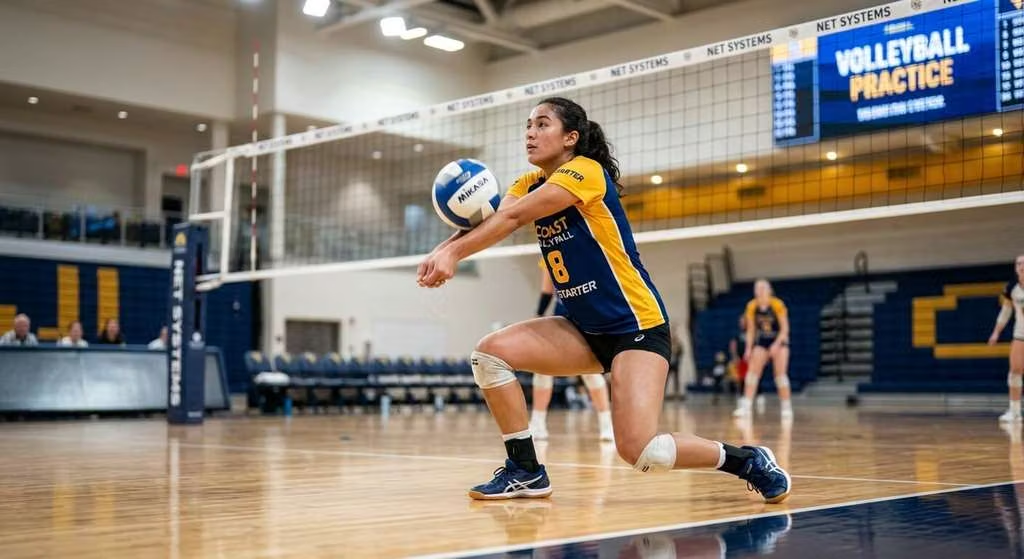
Day 1: Passing and Ball Control
- Objective: Build a stable forearm platform and master footwork before contact.
- Key Drills:
- Ready-position holds (3 sets × 10 seconds).
- Self-toss and forearm pass (3 sets × 10 repetitions).
- Wall passing (3 sets × 15–20 consecutive passes).
- Partner passing or wall target passing (3 sets × 10 passes).
- Shuffle-and-pass (2 sets × 6 reps per direction).
- Common Mistake to Avoid: Swinging your arms instead of lifting with your legs.
Day 2: Setting Fundamentals
- Objective: Learn correct hand shape, a high contact point above the forehead, and a soft push.
- Key Drills:
- Overhead catching (20 repetitions).
- Wall setting (2 sets × 15 repetitions).
- Self-set to target (3 sets × 8 repetitions).
- Setting footwork (3 sets × 6 repetitions).
- Partner or wall target setting (3 sets × 10 sets).
- Common Mistake to Avoid: Setting exclusively with your arms without leg extension or pointing thumbs forward.
Day 3: Serving Technique
- Objective: Develop a repeatable underhand or standing overhand serving motion.
- Key Drills:
- Serving stance and toss practice (10 reps without hitting).
- Underhand serving (2 sets × 10 serves).
- Standing overhand serving progression (2 sets × 8 serves).
- Target serving (3 sets × 5 serves).
- Serving consistency tracking (10 serves).
- Common Mistake to Avoid: Tossing the ball too low or hitting with a bent arm.
Day 4: Footwork, Agility, and Movement
- Objective: Improve balance, first-step quickness, and ready-position recovery.
- Key Drills:
- Ready-position hold repetitions (3 sets × 10 seconds).
- Lateral shuffles (3 sets × 20 seconds).
- Split-step practice (3 sets × 8 repetitions).
- Forward/backward movement (2 sets × 6 repetitions).
- Cone/marker agility patterns (3 sets × 30 seconds).
- Common Mistake to Avoid: Crossing your feet during lateral shuffles.
Day 5: Spiking Approach and Jumping Technique
- Objective: Learn safe approach footwork and arm-swing mechanics before adding power.
- Key Drills:
- Approach footwork without a ball (3 sets × 6 repetitions; left–right–left for right-handers).
- Arm-swing mechanics (3 sets × 8 repetitions).
- Standing hitting practice with a lightweight ball against a wall (3 sets × 8 hits).
- Controlled approach jumps (3 sets × 5 jumps with a two-foot landing).
- Partner toss-and-hit (3 sets × 6 attempts).
- Common Mistake to Avoid: Jumping off a single foot or landing stiff-legged.
Day 6: Combined Skills and Game Practice
- Objective: Link the week’s skills into fluid sequences and communicate effectively.
- Key Drills:
- Pass-to-set sequences (3 sets × 6 repetitions).
- Set-to-hit progressions (3 sets × 6 repetitions).
- Serve-receive practice (2 sets × 8 serves).
- Three-touch teamwork drill (3 sets × 5 sequences: pass–set–hit).
- Mini-game (10–15 minutes of 2v2 or 3v3).
- Common Mistake to Avoid: Standing still after making contact instead of covering your zone.
Day 7: Rest and Recovery
- Objective: Allow muscle adaptation, replenish energy stores, and prevent burnout.
- Guidance: Engage in 15–20 minutes of comfortable walking, gentle shoulder/hip mobility, and static stretching. Prioritize hydration and sleep.
Bonus Beginner Lessons & Advanced Foundations
To accelerate your learning curve while following any quality Volleyball Weekly Training Program for Beginners, integrate these extra conceptual and tactical lessons into your routine:
Lesson 8: Basic Court Positioning & Rotations
- Objective: Understand where you should stand on the court during a rally and how basic tracking works.
- Key Concept: Avoid crowding your teammates. Maintain a triangle or W-formation on defense so every zone of the court is covered. Learn basic shift patterns when the ball crosses the net.
Lesson 9: Communication and Court IQ
- Objective: Build vocal habits that eliminate confusion and prevent mid-air collisions.
- Key Drills:
- The “Mine” Call Drill: Practice calling “Mine!” or “Ball!” loudly and early on every self-tossed or partner-tossed ball.
- Covering Your Hitter: Practice tracking where the ball goes after an attack so you can recover loose balls.
Beginner Warm-Up & Cooldown Routine (8–10 Minutes)
Never skip your pre-training preparation. A proper routine protects your shoulders, knees, and ankles.
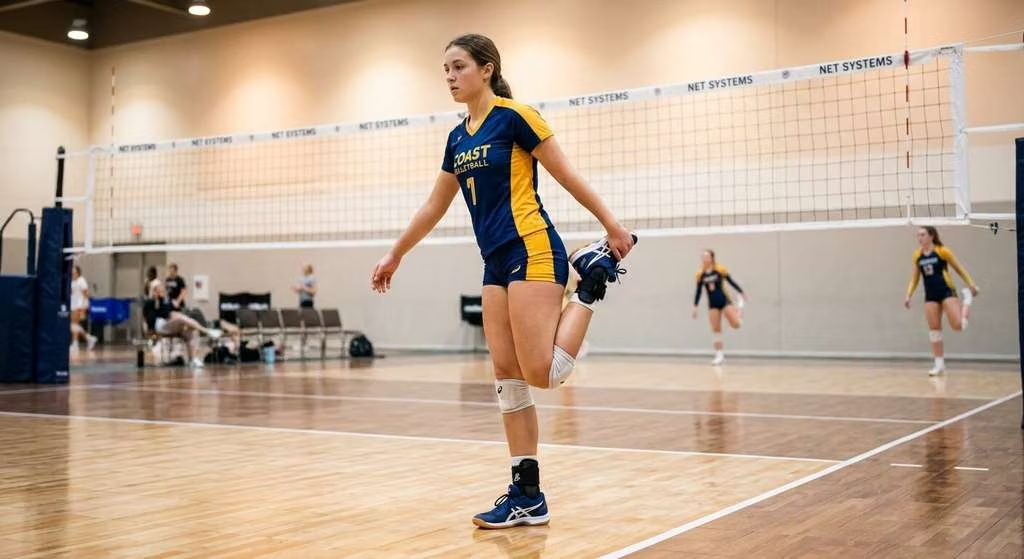
- Warm-up: 2 minutes of light jogging/walking, 10 forward/backward arm circles, shoulder mobility rolls, dynamic leg swings, bodyweight squats, side shuffles ($2 \times 15$ seconds), and 10 ready-position split-step transitions.
- Cooldown: 2 minutes of slow walking, gentle pain-free mobility work (calf stretches and arm crossovers), and a mental check-in for physical tightness.
Solo vs. Team Training Options
| Skill | Solo Training Option | Partner or Team Option |
| Passing | Wall passing, self-toss passing, target passing | Partner passing, serve-receive practice |
| Setting | Wall setting, self-set to wall target | Partner/triangle setting, setting to a hitter |
| Serving | Wall serving with marked height, target serving | Serving to a partner, receive practice |
| Footwork | Marker agility patterns, split-step drills | Reaction drills, game-situation footwork |
| Spiking | Shadow approach footwork, wall hitting | Partner toss-and-hit, set-to-hit sequences |
Four-Week Progression Plan
- Week 1 (Learn the Basics): Focus entirely on technique, balance, and control. Keep repetitions modest.
- Week 2 (Build Consistency): Repeat foundational drills and track successful attempts to beat your personal best streaks.
- Week 3 (Add Movement): Introduce dynamic footwork (shuffles and approach steps) before executing skills.
- Week 4 (Combine Skills): Practice multi-touch sequences, mini-games, and verbal communication on the court. For additional coaching frameworks, you can refer to structured plans like the YMCA Youth Volleyball Coaching Manual.
Common Beginner Training Mistakes to Avoid
- Practicing without warming up: Increases injury risk and stiffness.
- Chasing high rep counts over good form: Quality beats quantity every time.
- Serving too hard too soon: Prioritize accuracy and target zones over raw power.
- Over-jumping: Limit heavy vertical jumping early on to protect joints.
- Skipping rest days: Recovery is when true muscle adaptation and skill consolidation occur.
Frequently Asked Questions
1. How many days a week should a beginner follow this Volleyball Weekly Training Program for Beginners?
Most beginners thrive on 3 to 5 active sessions per week. Utilizing a proper Volleyball Weekly Training Program for Beginners offers six short training days and one recovery day, but you can scale the schedule to fit your personal recovery needs.
2. How long should each session last?
Aim for 30–60 minutes including warm-ups and cooldowns. Short, high-focus practices prevent fatigue-driven bad habits.
3. Can I learn volleyball completely alone?
Yes! You can build exceptional foundation skills using a brick wall, self-tosses, and target markers. However, combining solo sessions with partner or team games helps build real-world court awareness.
4. What equipment do I need to get started?
You only need a standard volleyball, a safe wall or open patch of space, and simple ground markers (like shoes or tape) to act as targets. Cones and resistance bands are entirely optional.



9 Comments