
Serving is one of the most important skills in volleyball. A good serve can put the opposing team under pressure, make passing more difficult, and create scoring opportunities before a rally even begins.
However, not every volleyball serve works the same way. Two popular serving techniques are the jump serve and the float serve. Both can be effective weapons, but they require different techniques, skills, and levels of control.
If you are learning volleyball or looking to improve your serving performance, you might wonder: Jump Serve vs. Float Serve: Which Is More Effective?
The jump serve is often associated with power, speed, and aggressive attacking. The float serve focuses on unpredictable ball movement, placement, and making it difficult for opponents to pass accurately.
In this guide, we will explain how each serve works, their advantages and disadvantages, the main technical differences, and how to choose the right serving technique for your skill level.
What Is a Jump Serve in Volleyball?
A jump serve is an attacking serving technique in which the player tosses the ball into the air, approaches, jumps, and contacts the ball above the playing surface.

It is commonly used by experienced volleyball players because it allows them to generate considerable power and create difficult receiving situations.
A jump serve can be performed with topspin or as a jump float serve. The topspin jump serve is particularly popular because the forward rotation helps the ball travel quickly and dip toward the court. You Can Learn Volleyball Weekly Training Program for Beginners
How to Perform a Jump Serve
Learning a jump serve requires coordination, timing, and consistent practice. Follow these basic steps:
1. Start Behind the End Line
Stand behind the volleyball court’s end line with enough space to complete your approach. Keep your body relaxed and focus on your target.
2. Toss the Ball
Toss the ball high enough to allow a comfortable approach and jump. For a topspin jump serve, the toss is usually placed slightly in front of your hitting shoulder.
3. Take Your Approach Steps
Use a controlled approach, similar to the footwork used for spiking. A common approach pattern for right-handed players is left-right-left.
4. Jump and Prepare Your Arm
Push off the floor with both feet and jump upward and forward. Draw your hitting arm back while keeping your eyes on the ball. You Can Learn Plyometric Training for Volleyball Players
5. Contact the Ball
Strike the ball with a firm, open hand near its center or slightly behind it, depending on the intended contact and spin. For a topspin serve, brush the ball to create forward rotation.
6. Follow Through and Land Safely
Allow your hitting arm to follow through naturally. Land with control and prepare to move into your defensive position.
Advantages of a Jump Serve
A jump serve offers several benefits:
- High attacking power: Players can generate greater serving speed through their approach and jump.
- Aggressive pressure: A powerful serve can challenge the receiving team’s formation.
- Topspin movement: Forward rotation can make the ball dip quickly toward the court.
- Scoring opportunities: A well-executed serve can produce an ace or force a difficult first pass.
- Strategic placement: Players can target specific receiving zones and seams.
Disadvantages of a Jump Serve
Despite its advantages, a jump serve also has some challenges:
- It requires good coordination and timing.
- Beginners may struggle with consistent ball tosses.
- Poor contact can send the ball into the net or out of bounds.
- It can be physically demanding.
- Developing a reliable jump serve usually requires considerable practice.
A powerful jump serve is useful only when you can control it consistently.
What Is a Float Serve in Volleyball?
A float serve is a volleyball serving technique designed to make the ball travel with little or no intentional rotation.
Unlike a topspin serve, a float serve does not rely on forward spin to create its movement. Instead, variations in airflow around the ball can produce unpredictable movement during flight.
This movement can make it difficult for the receiving player to judge the ball’s direction and landing point.
Float serves can be performed while standing or jumping. A jump float serve combines a small approach and jump with the same minimal-spin contact technique.

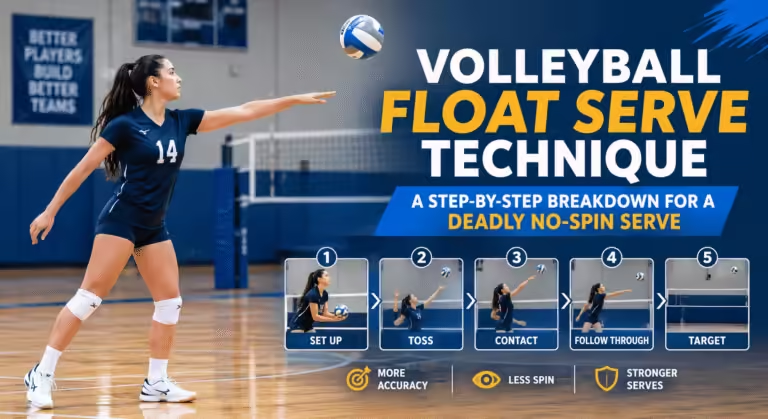
How to Perform a Float Serve
1. Position Yourself Behind the End Line
Stand comfortably behind the service line with your feet balanced and your body facing your target.
2. Hold the Ball Correctly
Hold the volleyball in your non-hitting hand at a comfortable height in front of your body.
3. Toss the Ball
Make a controlled toss slightly in front of your hitting shoulder. Avoid tossing it too high because a consistent, manageable toss helps improve accuracy.
4. Prepare Your Hitting Arm
Move your hitting arm backward and keep your elbow comfortably bent. Prepare for a firm, controlled contact.
5. Contact the Ball Firmly
Strike the center of the ball with a firm, open hand. Keep your wrist firm and avoid brushing the ball.
The goal is to minimize rotation so that the ball travels with a floating movement.
6. Maintain Your Balance
Follow through naturally and regain your ready position after serving.
Advantages of a Float Serve
A float serve provides several important benefits:
- Unpredictable movement: The ball can move unexpectedly during flight.
- Better placement opportunities: Players can target weak passing areas.
- Less emphasis on jumping power: A standing float serve does not require a vertical jump.
- Useful for beginners: Players can learn consistent contact without mastering a complex jump approach.
- Tactical pressure: Even a moderate-speed float serve can make serve reception difficult.
Disadvantages of a Float Serve
Float serves also have limitations:
- They may not generate the same speed as an aggressive topspin jump serve.
- Inconsistent contact can cause unwanted rotation.
- A predictable float serve can be easier to receive.
- Wind can affect the ball outdoors.
- Players need good accuracy and ball control to make the serve effective.
A float serve should not be considered an easy serve. Although its technique is relatively accessible, developing an effective and unpredictable float serve takes practice.
Jump Serve vs. Float Serve: Key Differences
Understanding the differences between these serving techniques can help you choose the right option for your playing style.
| Feature | Jump Serve (Topspin) | Standing Float Serve |
|---|---|---|
| Technique | Approach and jump | Standing position |
| Main purpose | Power and attacking pressure | Unpredictable movement and placement |
| Ball rotation | Forward topspin | Little or no rotation |
| Ball speed | Often higher | Usually moderate |
| Difficulty | Advanced | Beginner to intermediate |
| Physical demand | Higher | Lower |
| Accuracy | Requires practice | Easier to develop initially |
| Main advantage | Speed and dipping trajectory | Unpredictable flight |
Important: A jump serve and a float serve are not completely separate categories. A jump float serve is also possible. The main difference is that a topspin jump serve uses forward rotation, while a float serve aims to minimize rotation.

Which Serve Is More Powerful?
If your main goal is serving power, the topspin jump serve generally has the advantage.
The approach, jump, and overhead contact allow players to generate significant speed. Topspin also helps the ball dip downward, making it possible to serve aggressively while keeping the ball within the court.
A standing float serve usually focuses more on control and movement than maximum speed.
However, serving power alone does not determine effectiveness. A powerful serve that consistently goes out of bounds is less useful than a controlled serve that challenges the receiving team.
Winner for power: Topspin jump serve.
Which Serve Is More Difficult to Receive?
Both serving techniques can challenge receivers in different ways.
A powerful topspin jump serve gives the receiving team less time to react. Its speed and downward movement can make passing difficult.
A float serve creates a different challenge. Because the ball has little rotation, its flight can be unpredictable. Receivers may struggle to judge where it will land.
The effectiveness depends on serving accuracy, ball movement, speed, and the quality of the receiving team.
Best for speed pressure: Topspin jump serve.
Best for unpredictable movement: Float serve.
Which Serve Is Better for Beginners?
For most beginners, the standing float serve is a better starting point.
Learning to serve consistently is more important than trying to generate maximum power immediately.
A standing float serve helps beginners develop:
- Correct hand contact.
- Consistent ball tosses.
- Better serving accuracy.
- Body balance and coordination.
- Understanding of serving zones.
- Confidence during matches.
Once you can serve consistently over the net and target different areas, you can gradually learn more advanced techniques.
A jump serve should be introduced progressively when you have developed sufficient strength, coordination, and control.
Beginner recommendation: Start with the standing float serve before progressing to a jump serve.
Jump Serve vs. Float Serve: Which Is Better for Competitive Volleyball?
At competitive levels, both serving techniques can be valuable.
The topspin jump serve is often used by aggressive players who want to put maximum pressure on the receiving team.
The float serve is useful when a player wants to disrupt passing patterns, target a particular receiver, or create unpredictable ball movement.
Many experienced players develop more than one serving technique so they can adapt to different opponents and match situations.
For example:
- Use a powerful jump serve when you want to challenge the receiving formation.
- Use a float serve to target a receiver who struggles with unpredictable movement.
- Change serving direction to prevent opponents from becoming comfortable.
- Vary your serving depth to make the receiving team adjust its positioning.
The most effective serve is the one that creates the greatest difficulty for your opponent while remaining reliable for you.
7 Tips to Improve Your Volleyball Serving
Whether you prefer a jump serve or a float serve, these training tips can help improve your performance.
1. Develop a Consistent Ball Toss
Your ball toss affects your timing and contact quality. Practice tossing the ball to the same position repeatedly before adding a full serving motion.
2. Focus on Hand Contact
For a float serve, focus on firm contact in the center of the ball with minimal rotation. For a topspin jump serve, practice creating forward rotation through the correct hand action.
3. Practice Serving Accuracy
Set up targets in different areas of the opposite court. Practice serving toward the corners, deep zones, and areas between receivers.
4. Improve Your Jumping Technique
If you want to develop a jump serve, work on your approach, takeoff, arm swing, and landing technique.
5. Build Upper-Body Strength
Strengthen your shoulders, arms, and core through appropriate exercises. Good technique and gradual training progression are more important than simply lifting heavier weights.
6. Practice Under Match Conditions
Try serving after completing a short movement drill or practice session. This helps you develop serving consistency when you are physically active.
7. Track Your Serving Progress
Record how many serves land successfully, how many hit your intended target, and how many go out or into the net.
Tracking your performance helps you identify areas that need improvement.
Common Serving Mistakes to Avoid
Avoid these mistakes when learning either serving technique:
Tossing the Ball Too Far: An inconsistent toss makes it difficult to contact the ball correctly.
Hitting With an Unstable Hand: Weak or inconsistent contact can reduce control and produce unwanted ball rotation.
Ignoring Court Positioning: Always check that you are behind the end line when making contact with the ball.
Trying to Serve Too Hard: Beginners often sacrifice accuracy by focusing only on power.
Skipping Warm-Ups: Prepare your shoulders, arms, and legs before demanding serving practice.
Practicing Without a Target: Random serving repetitions may not develop the accuracy needed during matches. You Should learn Official volleyball information and rules.
Frequently Asked Questions (FAQs)
1. Is a jump serve better than a float serve?
A jump serve can be more effective when you want power and speed, while a float serve is useful for unpredictable movement and accurate placement. Neither is always better.
2. Which volleyball serve is easiest to learn?
The standing float serve is generally easier for beginners to learn because it does not require a jump approach or advanced timing.
3. Can a float serve be performed with a jump?
Yes. A jump float serve combines a jump with the minimal-spin contact technique of a traditional float serve.
4. Why does a float serve move unpredictably?
A float serve has little or no rotation. Changes in airflow around the ball can create variations in its flight path, making it difficult to predict.
5. Does a jump serve always have topspin?
No. A jump serve can be performed with topspin or as a jump float serve. The type depends on how the player contacts the ball.
6. How can I make my jump serve more powerful?
Improve your approach timing, jumping technique, core stability, arm swing, and contact point. Practice gradually rather than trying to hit the ball as hard as possible immediately.
7. How many times should beginners practice serving?
Start with a manageable number of controlled repetitions and increase gradually as your technique and fitness improve. Quality and consistency matter more than simply serving a large number of balls.
8. Can a float serve score an ace?
Absolutely. A well-placed float serve with unpredictable movement can pass through a receiving formation or land in an open area without being touched.
Conclusion: Jump Serve vs. Float Serve – Which Is More Effective?
When comparing the jump serve vs. float serve, the better option depends on your experience, playing style, and serving goals.
The topspin jump serve is a powerful attacking weapon that can challenge opponents with speed and a downward trajectory. The float serve focuses on accuracy, control, and unpredictable movement, making it a useful technique for beginners and experienced players alike.
If you are new to volleyball, start by mastering the standing float serve. Once you develop consistent contact, accuracy, and confidence, gradually work toward more advanced serving techniques.
Experienced players should learn to use both techniques strategically to keep opponents guessing.
Remember, a great volleyball serve is not just about power. It is about consistency, smart placement, and putting pressure on the opposing team.
Keep practicing, improve your technique, and make every serve count!